Nvidia GR00T 2: Robots Learn Hand Skills From Human Video
Nvidia's GR00T 2 transfers hand skills from human video to robots: 40% success with no training, 95% after five demos. Real-world limits remain large.
At the robotics conference CoRL in Austin, Texas, Nvidia unveiled GR00T 2, the second generation of its foundation model for robots. The model is meant to ease a core problem in the field: robots have mostly learned new manual skills by having people remote-control them for hours. According to The Decoder, this so-called teleoperation is expensive, slow and produces data that is only useful for one specific robot model. GR00T 2 relies on videos of humans instead.
A model that predicts the future in video
According to Nvidia, GR00T 2 is a so-called world-action model. Unlike the previous generation, GR00T 1, it does not translate camera images and language commands directly into motor movements. It computes the next movement and a short video of the immediate future at the same time. In other words, it predicts how the camera image should change when a gripper picks up an object, for example. According to Nvidia's research report, a single diffusion transformer handles future video and action chunk together, and small per-robot modules translate the plan into motor commands.
Through this video prediction, the model is supposed to transfer movement sequences between different robot bodies. Nvidia says it runs on parallel grippers, five-fingered hands and humanoids. According to The Decoder, training took place on a cluster of more than a thousand GB300 chips. Per Nvidia, the training mix consists of three kinds of data:
- 402,730 hours of egocentric video of people at work, recorded with head-mounted cameras
- 10,184 hours of demonstrations with a handheld UMI gripper across 2,897 tasks
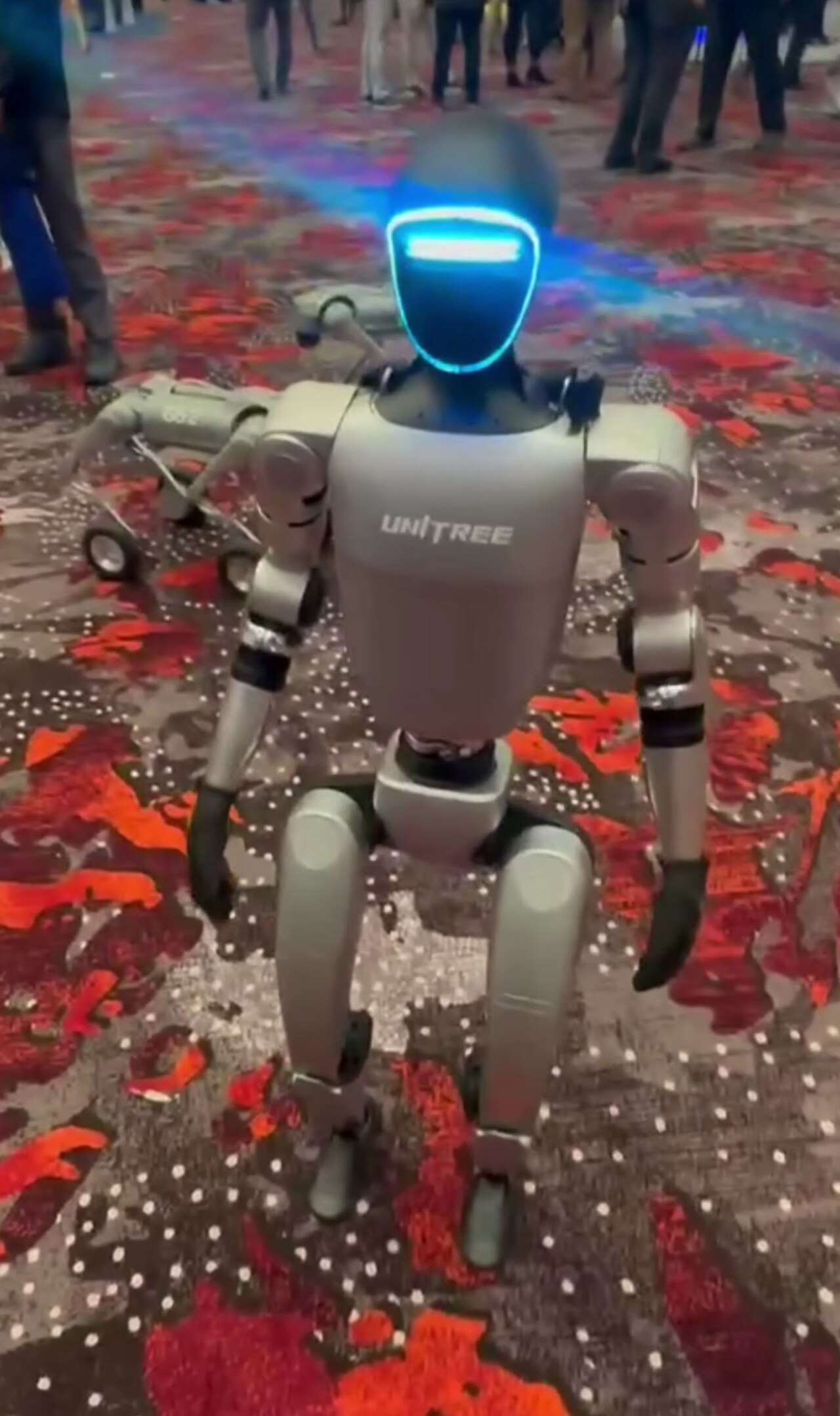
- 23,500 hours of robot teleoperation data, including arms with parallel grippers, Sharpa and Wuji hands, and the Unitree G1 humanoid
According to Nvidia, 100,000 hours of the human video are openly available on Hugging Face as Human-1M-100K. The Robot Report describes GR00T 2 as an open frontier world action model. We did not check the exact licence terms for the model weights in the sources we read.
What the numbers show, and what they do not
All results come from lab experiments and from Nvidia itself; none has been independently verified so far. On 50 tasks that the target robot had never practised, Nvidia says 40% succeeded with no demonstration on the robot. With one demonstration per task, the rate rose to 71%, and with five demonstrations, under three minutes of robot data in total, to 95%. According to Nvidia, a 30-minute fine-tune on a single RTX 5090 graphics card is enough.
Learning from human video alone is particularly notable. According to The Decoder, a robot with two five-fingered hands was able to light a match, cut a banana or toss packages onto a conveyor belt without having been teleoperated for those tasks. Success rates varied between 10 and 80% depending on the task. According to Nvidia, it is enough for a person to demonstrate the movements with data gloves, special handheld grippers or a finger exoskeleton. From a single video of a hammer blow, the system also learned to drive nails, by way of a simulation.
On fine-motor tasks with two Sharpa hands, Nvidia reports 85% success at seating GB300 memory modules and 65% at assembling a toy truck. Reinforcement learning on the real robot lifted three contact-rich insertion tasks to between 88 and 96%.
A language model as conductor, and as brake
For longer assembly jobs, Nvidia combines GR00T 2 with a higher-level AI language model that calls the software through an interface. According to The Decoder, this could be OpenAI's GPT-6 Astra, for example. The language model breaks the task into steps, marks grasp points in the camera image and starts helper routines when a part falls. Per Nvidia, the robot completed each of three toy models in at least 97 of 100 consecutive runs this way. Without the correcting language model and additional post-training, assembling the toy car succeeded in only 23 of 100 cases, according to The Decoder. With coloured grasp markers, the robot followed instructions 92% of the time, compared with 40% using the task instruction alone.
The price is speed: when sorting trash, the robot stood still for about a third of the time, according to The Decoder, because it had to wait more than seven seconds on average for the planning model. For two-legged robots, Nvidia therefore built the slimmed-down GR00T 2 Turbo. According to Nvidia, it needs 124 milliseconds per prediction and runs directly on the onboard Jetson Thor computer of the Unitree G1. The robot scooped popcorn in all 48 trials and cleared a table in 93% of trials. Wiping up liquid with a towel under its foot worked in only about half of the attempts, according to The Decoder.
Open hurdles for real-world use
- The model does not yet process direct sensor data for the sense of touch.
- It sometimes misses fine errors such as half-turned screws.
- Success rates fluctuate widely and are far below 95% on many tasks.
- The top-three rankings on benchmarks such as RoboCasa365, RoboLab, RoboDojo and MolmoSpaces are Nvidia's own claim.
At launch, Nvidia names partners testing the model: according to The Robot Report, Foxconn is applying it to factory automation for server manufacturing, Siemens is evaluating it for industrial use cases, and Nexuni is testing it for laundry. With Isaac Lab 3.0, Nvidia also released a new version of its open-source framework for training robots in simulation.
What this changes for companies in the United States
For US manufacturers and logistics operators, GR00T 2 is not yet a product to switch on, but it is a signal: teaching robots could shift from costly remote control towards videos and a handful of demonstrations. That is our assessment, not a statement from Nvidia. A sensible step is a small pilot on a task with many variants, where a failed grasp costs little and a success rate below 95% is tolerable. Companies that want to use video of employees as training material should involve privacy counsel and worker representatives early. Lab figures only become reliable once they are confirmed on your own parts and on your own floor.
Sources
- GR00T 2 zeigt Nvidias neuen Kurs bei KI-Modellen für RoboterThe Decoder · November 10, 2026
- GR00T 2: Scaling Robot Foundation Models for Generalization, Dexterity, and AdaptationNVIDIA Research (GEAR) · November 10, 2026
- NVIDIA launches GR00T 2 and Isaac Lab 3.0 at CoRLThe Robot Report · November 10, 2026