
Sell and take payments from your own website
Build a website to sell online — and keep it alive
Taking payment for a first order only solves day one. The real work comes next: keeping the offer up to date, tracking what the website collects and continuing to be found. Any tool can now produce decent pages in an evening; six months later, the website has not moved and reflects the business as it used to be. Here, going live is the first day, not the last: a team of agents takes over and runs the website — correcting it, expanding it, improving its SEO, feeding it and growing it month after month, without a new quote and without you having to think about it.
1. Why sites cost so much, then die
The price of a site is almost never in the code. It is in the back-and-forth: explaining your trade to someone who does not know it, receiving a mock-up that does not match, asking for a change, waiting, starting again. Each round costs days and is billed.
To which is added what the initial quote almost never covers: the copy, which the client ends up writing; the photos; then the later changes, billed by the hour.
But the real waste comes afterwards, and it is rarely named. The site is delivered, it is decent, and that is where it stops. Nobody has the budget for what follows, nobody has time to post, search visibility is never maintained. Six months on, the company is paying to host a frozen brochure that nobody finds any more. So the question is not “what does a site cost” — it is “who looks after it next month”.
2. What changes: a team takes over
Tools that produce pages are now plentiful, and much of a muchness. What did not exist is what comes next: instead of a delivered file, the company gets a team that keeps the site going over time.
In practice, going live closes nothing. The agents that built the site stay in place, each with its own brief: one maintains search visibility and tracks positions by keyword and by country, another posts regularly and points to the new pages, another handles incoming enquiries, another again keeps the customer file from what the site collects. The site stops being a deliverable and becomes the foothold of a visible business.
That is what moves the subject from price to duration. A site made once goes stale; a site that is kept transforms with the company — new offering, new market, new language — without having to ask for a quote each time, or track down the provider who built it.
3. How the build works
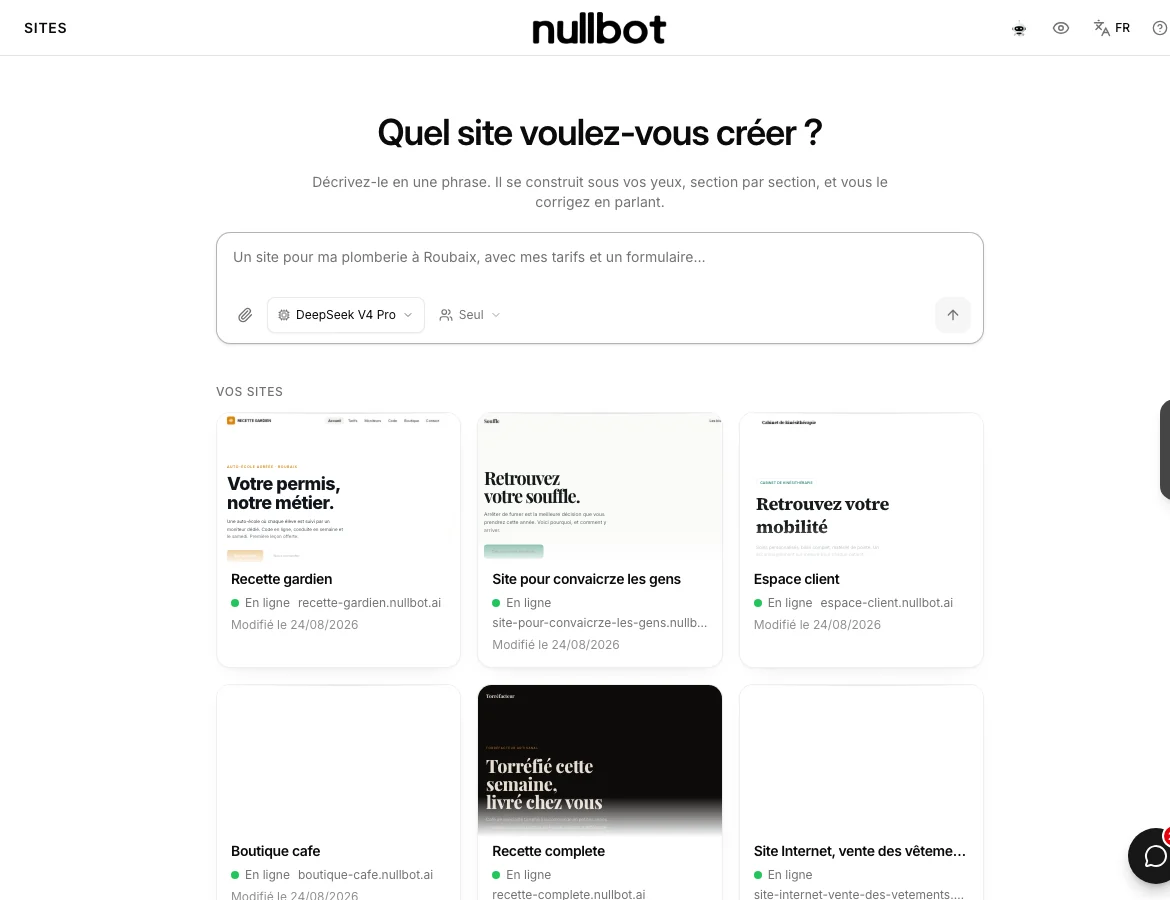
You describe your business, what you sell, to whom, and what the site should let the visitor do — find out more, book an appointment, buy, leave their details. In plain language, as you would explain it to someone joining.
The agent does not hand back a single take-it-or-leave-it proposal: it opens several directions, with different visual approaches, which you view as previews before choosing one. That is the moment the real decision is made, and it costs a few minutes instead of a week.
After that, everything is corrected by saying so: lengthen a text, change a colour, add a page, replace a photo. Images are searched and imported from within the studio, without a separate stock library. Each change produces a new version, and you can go back to a previous one if the result displeases — which changes the nature of the exercise: trying something costs nothing.
4. What the site can contain
Beyond presentation pages, a company site almost always needs three things that simple site builders do not provide.
- A form that arrives somewhere. Messages received are read from the studio, marked as read, and can feed an agent's work — keeping the customer file, or qualifying an incoming enquiry.
- A customer area. Your customers create an account and find their information there. Accounts are managed from the studio: view, reset a password, delete.
- Taking payment. A site can sell and take payment, with the payment provider declared by the project. It is an operation that touches money: it is set up explicitly, never by default.
The data the site collects — messages, accounts, orders — stays viewable and exportable. A site you cannot get your own data out of is a site you do not really own.
5. The domain name and going live
A site without an address does not exist. The domain name is searched and reserved from the studio: you check availability, choose, and the address is attached to the site. The price of a domain name depends on its extension and the country — it is a real expense, separate from the subscription, and it is stated before being committed.
Going live is a deliberate act: you publish when you decide to publish, not with every change. Until you publish, you work on a preview only you can see. After publication, the version history lets you go back — a site broken on a Friday evening is repaired by picking yesterday's version.
6. The life of the site: week 1, month 3, year 2
The best way to judge a tool is not to look at what it produces on day one, but at what the site becomes when nobody is actively tending it any more. Here is what “keeping a site” actually covers.
- The first week. You correct what use reveals: a text that does not say the right thing, a missing page, a badly placed form. By saying so, without a new quote.
- The first month. Search visibility gets under way — audit, keywords tracked, competitors identified — and the first posts go out. This is the moment when a conventional site has already stopped moving.
- The third month. Positions are measured by keyword and by country, readability by AI models is checked, pages that bring nothing get rewritten. Incoming enquiries feed the customer file instead of sleeping in a mailbox.
- The second year. The site no longer resembles the one you started with, because the company has changed: new offering, new markets, sometimes new languages. It kept up, without having to track down the original provider or reopen a budget.
That continuity is what separates a presence online from a frozen brochure. And it is exactly the work the company could not afford to entrust to anyone: too irregular to justify a post, too expensive to outsource monthly, and never urgent enough to be done yourself.
7. The limits, stated plainly
Better to know them before starting than after publishing.
- A vague description gives a vague site. That is the main limit, and it does not come from the technology. If you cannot say what the visitor should do on the page, no tool will guess it for you.
- It is not a brand identity. A crafted logo, a style guide, positioning written to the word remain a professional's trade. The tool produces a coherent, clean site, not an art direction.
- A complex business application is not a website. An intranet with rules specific to your company is beyond this scope — that is a different project.
- Taking payment commits you. Selling online implies terms of sale, a refund policy and obligations that fall to you. The tool sets up the payment; it does not exempt you from the legal framework.
8. Frequently asked questions
Do I need to know how to code to build my site?
No. The site is described in plain language and corrected by saying so. What is required is not a technical skill but clarity: being able to say what you sell, to whom, and what the visitor should be able to do on arriving at the page.
Does the site belong to me?
The content and the data collected — messages, customer accounts, orders — are yours and can be exported. The domain name is registered in your name. That is the point to check with any provider before committing, here included: a site you cannot get your data out of is a site you rent, not one you own.
Can I change the site after it goes live?
Yes, by asking, as often as needed and without a new quote. Each change creates a version, and the history lets you go back if the result does not suit you. That is exactly what fixed-price sites lack: they stop evolving for want of budget for the next round.
Will the site rank well on Google?
The technical groundwork is laid at publication, but no tool can promise a position: it depends on your market, your competitors and the age of the domain. What can be steered is the search work itself — audit, position tracking by keyword and by country, readability by AI models — kept up continuously rather than done once and for all.
What if I also want a mobile app?
A mobile version of the site is generated from the same project. A true app, installable and published on the App Store and Google Play, comes from a separate studio that works on the same principle: you describe, you try it in an iPhone and Android simulator, then you publish.
Going further
Read next: what a post really costs, search visibility tracked continuously, or what an autonomous AI agent is.