Google unveils TPU 8tx and 8i Max chips for agents and security
Google announced two eighth-generation TPUs on Nov. 9, 2026: the confidential TPU 8tx with AMD CPUs and the TPU 8i Max with doubled compute. Both target AI agents.
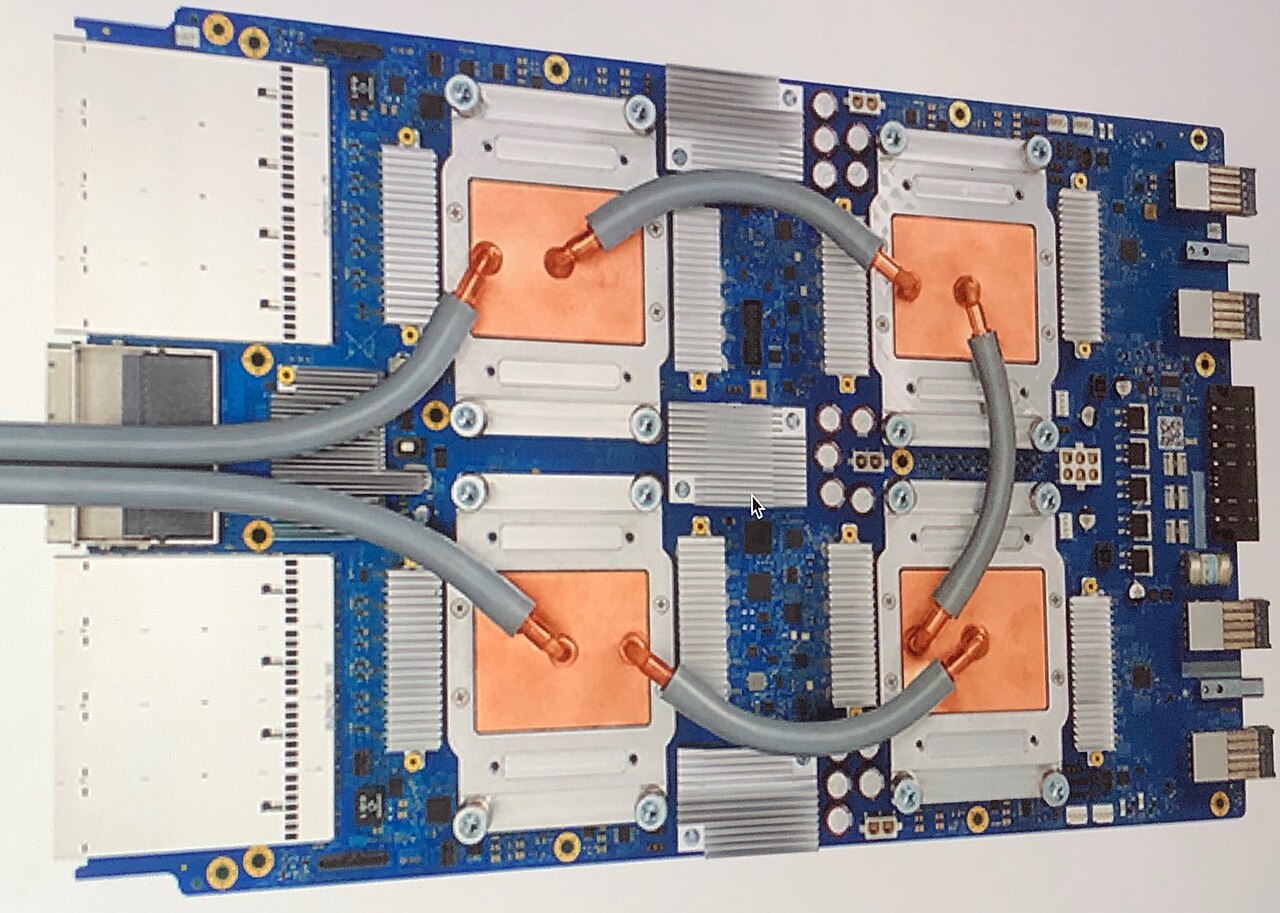
On November 9, 2026, Google introduced two new systems in its eighth-generation TPU family: the TPU 8tx and the TPU 8i Max. According to Google, it is the first time the company has launched four TPU systems in a single year. As reported by Gigazine, the TPU 8tx pairs with AMD CPUs to process confidential data securely, while the TPU 8i Max combines two chips in one package to raise processing performance.
A TPU (Tensor Processing Unit) is a processor Google designs for training and running artificial intelligence. At Google Cloud Next in April 2026, the company had already introduced the TPU 8t for large-scale training and the TPU 8i for real-time reasoning. Google says they deliver up to 2.7 times better training performance and 80% better inference price performance, respectively, than the previous generation. The two new systems join that pair.
TPU 8tx: protecting data while it is being processed
Data is normally encrypted when stored or sent over a network, but it has to be unlocked in memory while a computer processes it. Confidential computing aims to protect data in use, along with the AI model weights themselves. That matters to companies and governments that want autonomous agents to handle sensitive information.
According to Google, the TPU 8tx is built on the same silicon as the TPU 8t and is paired with 5th generation AMD EPYC CPU hosts. Security is built into the hardware layer, so sensitive data and model weights stay protected and isolated even while in active use. The system also adopts Boardfly, the low-latency network Google created for real-time reasoning, which Google says delivers up to 2x lower latency than the TPU 8t with a near-zero performance penalty.
The TPU 8tx also handles small-scale training. Teams can fine-tune models on private data, distill large models into smaller ones and train agents through reinforcement learning, without moving sensitive data between separate clusters. Google positions it for regulated enterprises and governments running frontier or proprietary models and autonomous agents alongside their most sensitive data.
TPU 8i Max: tackling the memory wall
The amount of information an AI can consult at once is called its context window. When dozens of AI agents work across an entire software codebase or hours of video, memory bandwidth quickly becomes the bottleneck. Google calls this the memory wall.
To address it, the TPU 8i Max combines two low-latency TPU 8i chips on a single package. Google says it delivers double the compute, double the SRAM and double the HBM bandwidth of the TPU 8i. Because it fits twice the silicon within the existing rack footprint, data centers can deploy more computing power per square foot and per watt.
- Announced: November 9, 2026 (Google blog)
- Four eighth-generation TPU systems: 8t (training), 8i (inference), 8tx (confidential), 8i Max (large context)
- TPU 8tx: up to 2x lower latency than TPU 8t, near-zero performance penalty (Google)
- TPU 8i Max: compute, SRAM and HBM bandwidth each doubled versus TPU 8i (Google)
A new system, not a new chip
Google draws a line between designing a chip, a multi-year process, and building a system, which rearranges compute, networking, storage, packaging and security around the chip. That modularity, it says, lets it deliver specialized machines in months rather than years. According to Gigazine, CEO Sundar Pichai said that co-designing with Google DeepMind researchers lets the company keep innovating for customers without waiting for the usual semiconductor cycle.
On the software side, Google says TorchTPU, open-sourced last month, lets PyTorch code and Hugging Face models run natively on TPUs without rewrites. TPU backends also exist for inference engines such as vLLM and SGLang. A new open-source TPU agent suite, in preview, plugs into coding tools like Claude Code, Cursor and Google Antigravity to automate TPU onboarding. Google says it has nearly 100 TPU customers, including frontier labs, trading firms, retailers and universities.
What is still unknown
Availability dates and prices for the TPU 8tx and TPU 8i Max had not been disclosed when Gigazine wrote its article. Every performance figure above comes from Google, and the sources we read contain no independent measurement. Some outlets, such as Korea's AI Times, frame the chips as chasing Nvidia, but the two sources we could read do not compare them directly with Nvidia GPUs. The rivalry is market context, not a measured result.
What this changes for businesses
For companies in banking, healthcare or the public sector that are weighing AI agents, the announcement widens the menu of options: fine-tuning or distilling a model on private data without taking it out of a protected environment is a point for teams worried about data leaks. Until dates and prices are published, it is prudent to wait for official information before planning a deployment. The announced PyTorch compatibility does give teams that already have AI engineering a first gauge of the migration effort.
Sources
- Googleが新型AIチップ「TPU 8tx」「TPU 8i Max」を発表、AMD製CPUを採用した機密情報保護モデルと処理性能2倍のモデルが登場GIGAZINE · November 10, 2026
- Our newest TPUs: 8tx and 8i Max, built for the agentic eraGoogle (The Keyword) · November 9, 2026