Apple maps local AI limits from iPhone to Mac Studio clusters
Apple’s published capability chart places 14-billion-active-parameter models on selected iPhones and iPads, while Mac Studio clusters are rated for models exceeding 1.6 trillion parameters.
On 26 September 2026, reports citing an Apple capability chart said the company has outlined how large a language model different iPhone, iPad and Mac configurations can run locally. The chart places devices with 16GB of unified memory in the range of models with up to 14 billion active parameters, while a cluster of Mac Studio systems is presented as capable of supporting models above 1.6 trillion parameters under specified conditions.
The figures are a capacity guide rather than a promise that every model at a given size will deliver the same speed, quality or memory use. Apple’s reported matrix connects local inference capacity to unified-memory size and memory bandwidth. That distinction matters because a model’s architecture, quantization and software optimisation can materially affect whether it fits and how useable it is on a particular device.
A hardware ladder for local inference
At the lower end, Apple lists iPhones and iPads equipped with 16GB of unified memory for models of up to 14 billion active parameters. The chart also identifies 76GB/s of memory bandwidth as a reference point for this level of local AI inference. TechNews and Wccftech both report that the A20 Pro has 115.2GB/s of bandwidth, above that cited threshold, though the available material does not establish performance results for a specific model on a specific phone.
The next tier covers MacBook Air and Mac mini systems. Apple rates those machines for language models with up to 70 billion active parameters, according to the reports. Wccftech says the relevant configurations can provide up to 64GB of unified memory and up to 307GB/s of memory bandwidth. Apple’s education community had previously said an M5 Pro Mac mini could run models up to that 70-billion level locally, including examples such as Llama 3.3 70B and Qwen 3.6 35B.
- iPhone and iPad with 16GB unified memory: up to 14 billion active parameters.
- MacBook Air and Mac mini: up to 70 billion active parameters.
- Top-end MacBook Pro: up to 120 billion AI models.
- M5 Ultra Mac Studio: up to 480 billion parameters locally.
- Mac Studio clusters: more than 1.6 trillion parameters, according to Apple’s chart.
Mac Studio is the upper single-machine tier
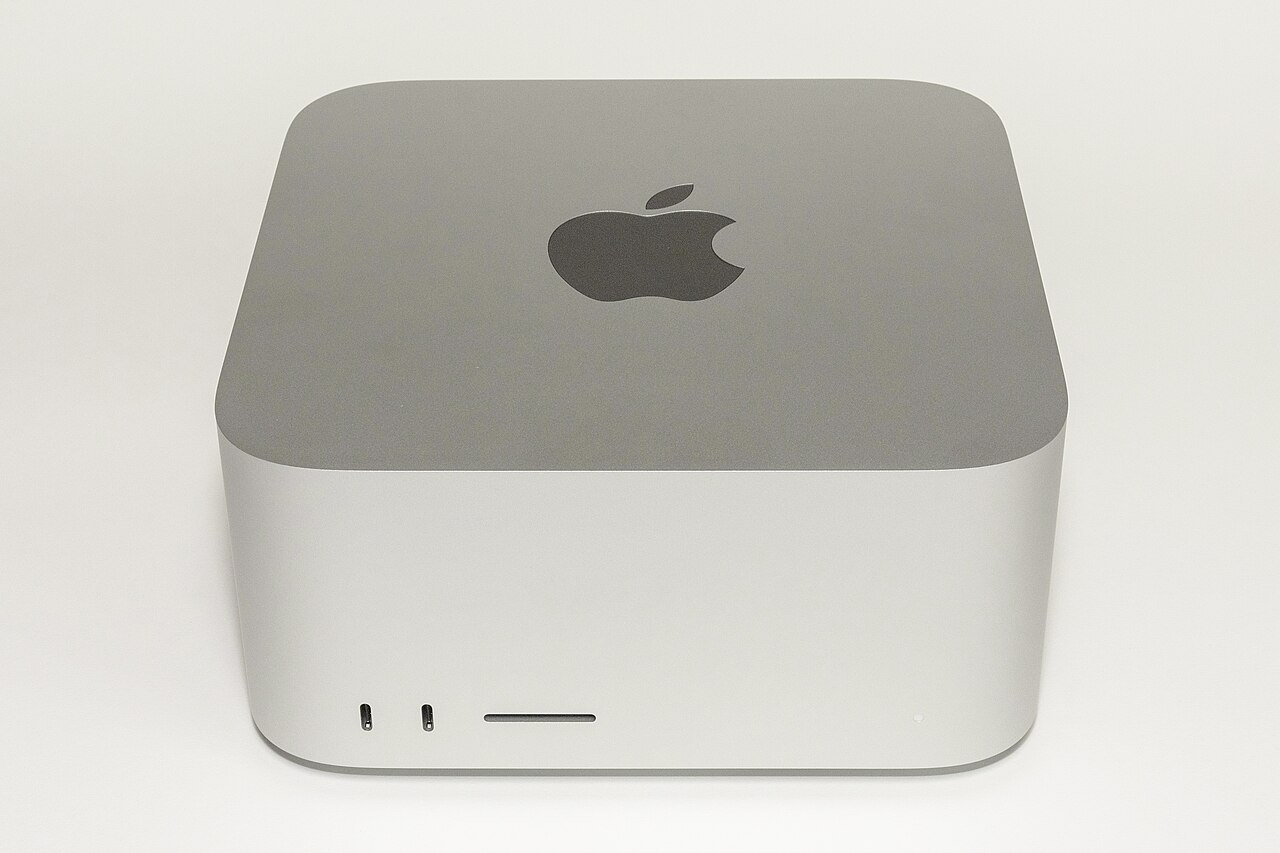
For the most demanding single-system use, Apple positions the M5 Ultra Mac Studio at up to 480 billion parameters. The reported specifications include up to 512GB of unified memory and memory bandwidth of up to 1.2TB/s, alongside a CPU with up to 36 cores and a GPU with up to 80 cores. The Apple education community’s account cited by TechNews is consistent with the 480-billion figure for one Mac Studio.
That number should not be read simply as a measure of intelligence. Parameter counts describe the scale of a model, but they do not by themselves specify response quality, context length, token generation speed or the precision at which weights are stored. The source material also uses both “active parameters” and broader parameter counts in its descriptions. Readers therefore cannot assume that every number represents identical measurement conditions across all devices.
Clusters extend capacity, but practical details remain open
Apple’s chart is reported to put a multi-machine Mac Studio cluster above 1.6 trillion parameters. TechNews says several Mac Studio machines can raise capacity to 1.6 trillion parameters, while Wccftech describes a four-system cluster with total unified memory of up to 2TB. Wccftech further says that a trillion-parameter model would require an eight-cluster configuration, illustrating that the reported cluster figures depend on configuration and may not map neatly onto a single purchase.
The reports leave important operational questions unanswered. Wccftech notes that Apple did not provide examples of which language models should be used on each device or how much of a quantized version each configuration would support. No token-per-second results, supported runtimes, networking requirements for clusters, power consumption figures or model-specific benchmarks are included in the supplied material. Those omissions limit direct comparisons with cloud services or other inference hardware.
For users, the immediate significance is that Apple is framing local AI across a broad product range rather than only in data-centre terms. Local execution can allow work without a network connection and can keep processing on the device, while making hardware costs more visible upfront. In markets where privacy, connectivity and predictable recurring spending matter, the chart offers a useful starting point. It is not, however, a substitute for checking the memory configuration, the model format and the actual workload before choosing an iPhone, Mac or cluster for local AI.