Apple's new M6 and M5 Ultra chips target local AI inference
Apple unveiled new Mac mini and Mac Studio models on August 25, 2026, built around the M6 and M5 Ultra chips, both explicitly designed to run AI workloads on-device rather than in the cloud.
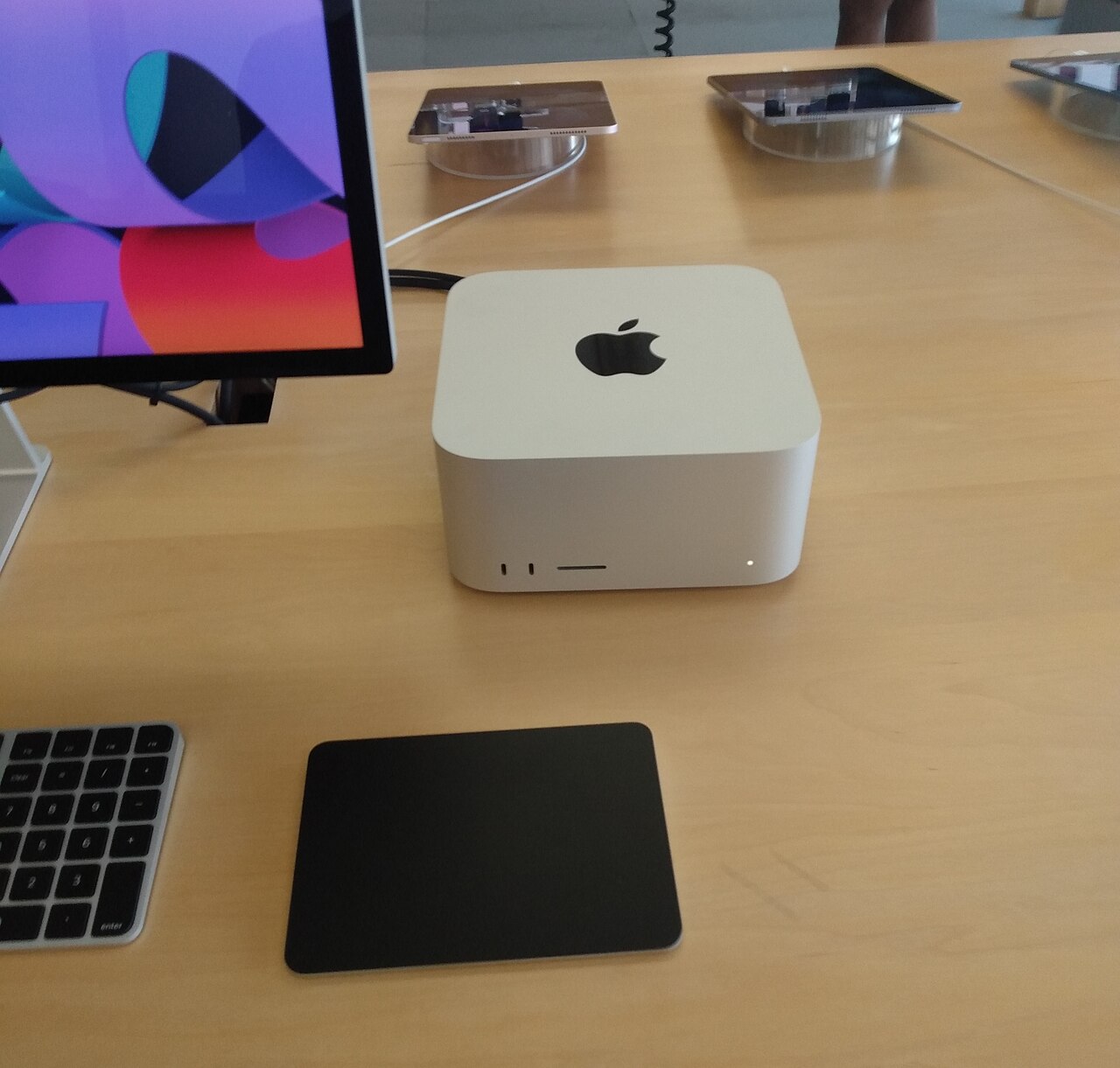
Apple announced new Mac mini and Mac Studio desktop computers on August 25, 2026, powered by two new chips, the M6 and the M5 Ultra, that the company positions squarely around artificial intelligence performance. Both machines have already built a following among developers and hobbyists who run large language models locally instead of paying for cloud inference, and Apple's new marketing leans into that use case rather than treating it as a side benefit.
The Mac mini and Mac Studio owe their popularity for local AI work to Apple's unified memory architecture, which lets the CPU and GPU share the same pool of fast memory instead of copying data between separate chips. That advantage grew sharper after macOS 26.2 shipped in December, adding low-latency communication between machines connected over Thunderbolt 5. The update made distributed inference practical through MLX, Apple's open-source framework built to exploit unified memory on M-series chips, and it is what allows several Mac mini or Mac Studio units to be chained together to run models too large for any single consumer machine.
The M6: three kinds of cores on one chip
The M6, built on a 2-nanometer process, is the first Apple silicon chip to combine three distinct core types on a single CPU: two new "super cores" alongside four performance cores and six efficiency cores, for 12 CPU cores in total. Apple claims up to 40 percent faster multi-threaded performance than the M4. The GPU gains two cores over the previous generation, for 12 GPU cores, and unified memory bandwidth reaches up to 160 GB/s, though total memory on the M6 is capped at 32 GB. Apple also says the chip's dual Neural Engine runs twice as fast as its predecessor, with a dedicated Neural Accelerator added to every GPU core, and claims the M6 Mac mini delivers up to four times the AI performance of the M4 model.
The M5 Ultra: four chips fused into one
The Mac Studio's new M5 Ultra is, in Apple's own description, literally two M5 Max chips fused onto a single package — and since each M5 Max already combines multiple dies, Apple calls the M5 Ultra its first chip built from four dies joined together. It packs 36 CPU cores (12 super cores and 24 performance cores), 80 GPU cores, unified memory bandwidth of up to 1.2 TB/s, and up to 512 GB of unified memory, by far the most memory available on any Apple silicon machine. Apple states the M5 Ultra delivers up to 4.3 times the AI compute of the three-generations-older M3 Ultra. Multiple Mac Studio units can also be linked together over Thunderbolt to pool their memory: Apple says four chained units together can reach up to three times the AI inference throughput of a single machine.
- New N1 wireless chip adding Wi-Fi 7 and Bluetooth 6 support
- Storage up to twice as fast as the previous generation, at up to 15 GB/s
- Mac mini ships with 2.5 Gb Ethernet standard, with a 10 Gb upgrade option
- Mac mini starts at $899 (16 GB, M6); an M5 Pro configuration starts at $1,699
- Mac Studio starts at $2,499 (M5 Max); an M5 Ultra configuration starts at $5,499
- Preorders opened the day of the announcement, shipping September 22; the 512 GB Mac Studio configuration ships in late October
A crowded race for the AI box under the desk
Apple frames the push in explicitly agentic terms, promising on the Mac mini page "a considerable leap forward in AI performance that powers the desktop computer market leader for continuous agentic computing." The pitch responds to a real cost problem: more developers now rely on AI coding agents such as Claude Code or Codex, but cloud model usage bills climb quickly at scale, while open-weight models such as Qwen or DeepSeek can run locally without a per-token charge. Standard consumer hardware still falls well short of running the largest of those models on its own, which is exactly why chaining several Mac mini or Mac Studio units together has become a workaround, and a comparatively affordable alternative to specialized Nvidia GPUs.
A considerable leap forward in AI performance that powers the desktop computer market leader for continuous agentic computing.
Apple is not alone in targeting this niche. Nvidia, with Dell, sells the DGX Spark with 128 GB of unified memory; Microsoft has a compact Surface device capable of running 120-billion-parameter models; Minisforum builds machines aimed directly at Mac mini buyers; and Xiaomi has its own AI Cube built around an in-house chip. On raw memory capacity, though, the Mac Studio's 512 GB keeps Apple clearly ahead of that field for now. Part of the promised AI experience still depends on macOS 27, code-named "Golden Gate," and a reworked Siri that remains in beta ahead of a fall release.
For developers and IT teams, the practical shift is that a desktop computer bought off the shelf, rather than a rack of specialized accelerators, can now realistically host a large open-weight model for a team, cutting the recurring per-token cost of cloud-based coding agents and keeping proprietary code off third-party servers. It also gives smaller companies and independent developers a genuine, if still expensive, path to running frontier-scale open models without negotiating GPU cluster access — a meaningful shift in who gets to experiment with large-scale local inference at all.
Sources
- Apple's new desktop computers are designed specifically for local AI developmentArs Technica · August 25, 2026
- Puce M6, Mac mini, Mac Studio... Le vrai sujet d'Apple, c'est l'IA localeFrandroid · August 25, 2026