AMD unveils a workstation for trillion-parameter AI
At IFA 2026, AMD unveiled the Threadripper Halo Station, a desktop workstation with 96 cores and two to four Instinct MI350P accelerators, which the company says can run AI models with more than 1 trillion parameters entirely on-premise.
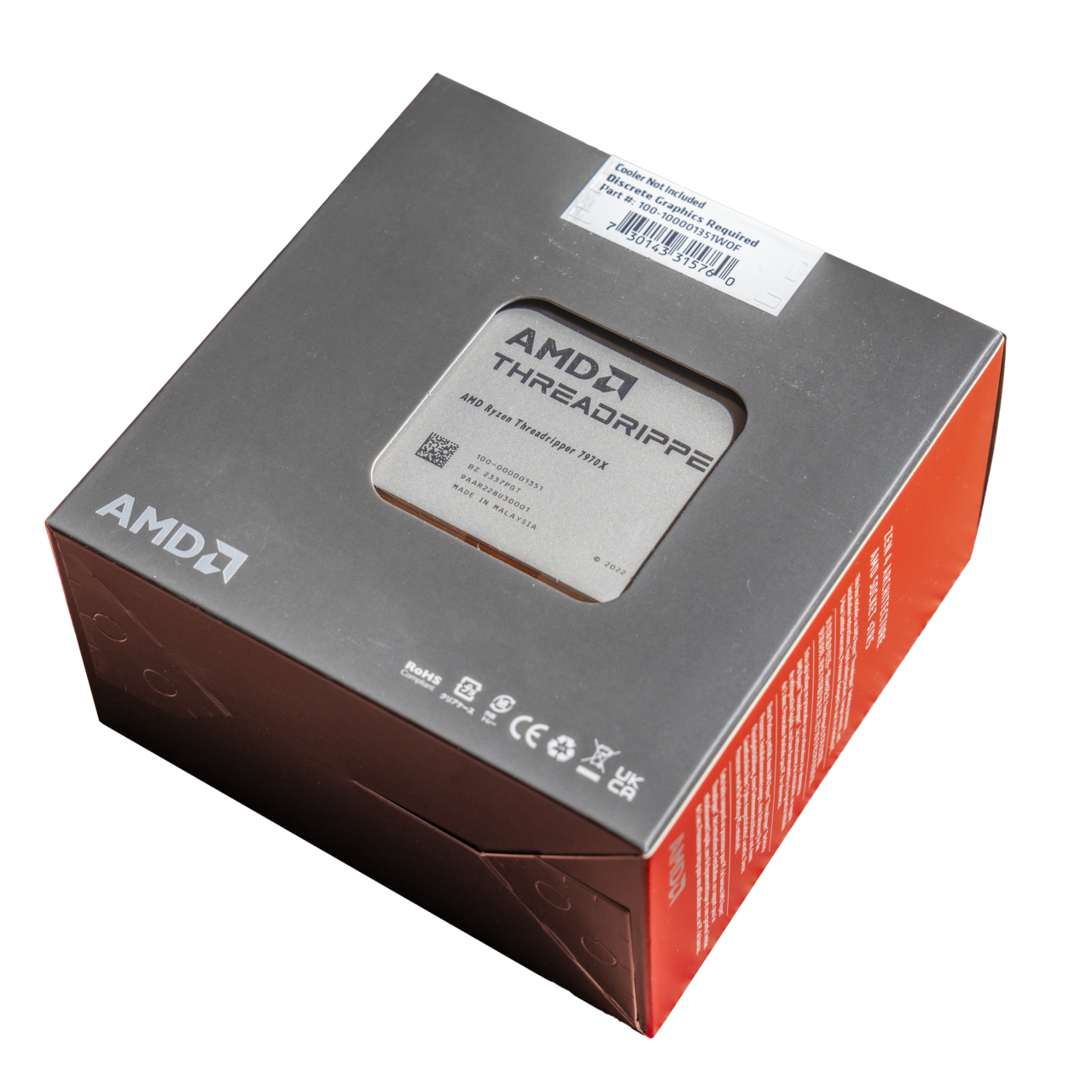
At the IFA 2026 trade show, AMD unveiled the Threadripper Halo Station, a workstation the company describes as bringing data-center-class compute into a desktop tower. According to ZDNet France, the goal is to run AI models with more than 1 trillion parameters locally, a size previously reserved for cloud server clusters.
A server chip inside a desktop tower
At the machine's core sits the AMD Ryzen Threadripper PRO 9995WX processor, built on the Zen 5 architecture: 96 cores, 192 threads, a boost clock up to 5.4 GHz and 384 MB of L3 cache, for a 350 W TDP, according to Tom's Hardware. It can be paired with up to 2 TB of DDR5 memory across eight channels, the maximum configuration the chip supports.
AI acceleration comes from AMD Instinct MI350P GPUs, announced in May 2026 and built on the fourth-generation CDNA architecture, manufactured on TSMC's 3 nm process. Each accelerator carries 144 GB of HBM3E memory and connects over PCI Express 5.0. The reference configuration ships with two, for a total of 288 GB of GPU memory; AMD says the system can scale up to four accelerators, which would raise that total to 576 GB.
- CPU: AMD Threadripper PRO 9995WX, 96 cores / 192 threads, up to 5.4 GHz
- Accelerators: 2 to 4 AMD Instinct MI350P GPUs (CDNA 4), 144 GB HBM3E each
- System memory: up to 2 TB of DDR5
- Combined memory: up to 2.6 TB, aggregate bandwidth up to 16.4 TB/s
- Power draw: 350 W for the CPU, 600 W per accelerator, about 1,550 W in the two-GPU reference configuration
- Fully liquid-cooled, CPU and GPUs alike
Why run AI locally instead of in the cloud
By betting on a desktop machine rather than remote servers, AMD is addressing a very concrete problem for researchers and developers: the rising bill for cloud inference on the heaviest AI models, ZDNet notes. Running a trillion-parameter model normally requires several data-center GPUs rented by the hour; the Threadripper Halo Station proposes owning that capacity outright, without depending on a cloud provider's availability or pricing.
AMD's own website, cited by ZDNet, states that the machine specifically targets teams limited by cloud access or shared infrastructure, as well as those that must keep sensitive data in-house. That is where the other argument for local compute comes in: confidentiality. A model run on a machine sitting inside a company's own premises sends no data to a third party, a decisive point for pharmaceutical research, defense or financial services.
AMD versus Nvidia on local AI
Technically, the Threadripper Halo Station is, per Tom's Hardware, essentially a server tray repackaged into a tower: a chassis designed for data-center EPYC chips, into which AMD has swapped in a Threadripper. The contest is not fought on raw compute power, where Nvidia keeps the edge with its Blackwell chips, but on onboard memory capacity — the factor that determines how large a model a machine can load at once. By stacking up to 576 GB of HBM3E on top of 2 TB of DDR5, AMD is aiming to outdo rival workstations built around Nvidia GPUs.
The most powerful AI workstation in the world, capable of running trillion-parameter models.
That approach comes at a price: Tom's Hardware estimates the street price at over $100,000 for the core components alone (processor, memory, two accelerators), and over $150,000 once storage, power and cooling are added — a range comparable to the Lenovo ThinkStation P8, a Threadripper Pro workstation with Nvidia Blackwell GPUs priced at $334,463 fully maxed out. AMD has not announced an official price for the Threadripper Halo Station, nor named an OEM partner to build it: ZDNet reports a planned rollout starting in 2027 through major PC makers.
What this changes for companies outside the US
For organizations outside the United States that want to run generative AI without routing their data through an American cloud — a concern sharpened by data-protection rules and by ongoing debates over digital sovereignty — a machine of this class offers a concrete path: training or running a large model on premises, with a fixed infrastructure cost instead of an inference bill that grows with usage. Even so, the Threadripper Halo Station remains a reference design for now, with no firm price or availability date, and its announced entry ticket — several hundred thousand dollars once fully configured — puts it within reach of major labs, specialized IT integrators or well-funded R&D departments rather than a typical mid-sized company.
Sources
- AMD présente une station de travail capable de faire tourner des IA à mille milliards de paramètresZDNet France · September 5, 2026
- AMD unveils Threadripper Halo Station, an AI workstation packing 96 cores and dual liquid-cooled MI350P acceleratorsTom's Hardware · September 5, 2026